The degree of job security for tenured faculty is higher relative to other kinds of jobs, but whether it is excessive is a different question.
The tenure system provides higher job security than a for-profit company would, but the monetary compensation is lower.
The correct view of the tenure contract is that universities get high-priced talent at a low monetary cost; they pay instead by providing job security.
While tenure provides job security, it doesn't guarantees a lifetime increase in salaries.
The disincentive of tenure system:
Untenured faculty view tenure as a incentive to work hard, but the desire to earn tenure also makes them cautious during the pre-tenured years. Many of them fear that unconventional teaching would impair their chance to get the tenure and thus they conform to conventional teaching and research topics that would pay off in a shorter time period. But when they take such mainstream teaching styles and research methods, the cost of innovative research and teaching at post-tenure career would be huge because they have locked in and failed to adopt more daring ways.

9/16/2013
Dining and Housing
Student dining and housing are enterprise units in some schools, which means that they are expected to fully cover their operating and capital costs and receive no subsidies from the general operating budget of the university. But their operation still have impact on the rest of the university.
Higher dining rates increase the total costs of attending the university. It is the total cost of attending the school, not its tuition and fees, that influences accepted students' decisions to attend the school. It is also the total costs that determine the financial aid that is provided for students. Increased financial aid costs or reduced tuition revenues both mean that less money will be available to spend on the academic functions to the universities.
Higher dining rates increase the total costs of attending the university. It is the total cost of attending the school, not its tuition and fees, that influences accepted students' decisions to attend the school. It is also the total costs that determine the financial aid that is provided for students. Increased financial aid costs or reduced tuition revenues both mean that less money will be available to spend on the academic functions to the universities.
Intercollegiate athletics and gender equity
Even if the athletics department loses money on its operation, the claim is made that these sports are investments that generate considerable funding in the form of alumni contributions to the university as a whole.
A number of academic studies confirm that football bowl game appearances and basketball appearances in the NCAA men's basketball tournament have a positive effect both on the contributions that universities receive from alumni and on the quality of their entering students.
Intercollegiate athletics is more a participation activity than a spectator activity for students at Ivy League universities.
Public universities have long used success on the athletic field as a way of generating alumni and political support for their institution. To compete on the playing field with the public institutions in their conferences, Stanford, Duke, and Northwestern have all adopted the conference policy of awarding athletic scholarships.
Gender-equity efforts will have real financial cost if a university isn't able to bring itself to deeply cut male athletic programs. Sometimes gender-equity requirements add to the cost of existing women's sports.
9/15/2013
State higher education cuts
Every state but Vermont is required by its constitution to balance its budget every year. In recessions when tax revenues fall and social welfare expenditure like Medicaid and TANF increases, either tax should be increased or some other public expenditure has too be cut.
But this can only explains the case of community colleges.
Baumol disease problem in higher education. It doesn't fully explain why college tuition is rising so much.
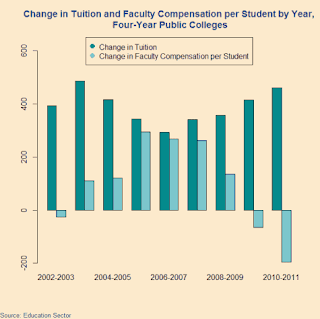 Now that there are many more PhDs, especially in the humanities, than
tenure-track spots for them, the salaries of instructors are actually
falling as universities turn to adjuncts. That directly contradicts the
Baumol explanation.
Robert Martin at Centre College did a research showing that between 1987 and 2008, full professor salaries increased by an average of 0.9 percent a year, and assistant professor salaries by a measly 0.7 percent a year. But support staff salaries grew at more than double that rate. If the core act of teaching is driving costs higher, that just shouldn't be happening.
A more plausible theory might be Bowen theory: universities will spend all the money they can possibly raise. If they raise more than they need for educational objectives, they will spend it on non-educational uses like climbing walls and nicer buildings.
Revenue theory of cost:
"
But this can only explains the case of community colleges.
Baumol disease problem in higher education. It doesn't fully explain why college tuition is rising so much.

Robert Martin at Centre College did a research showing that between 1987 and 2008, full professor salaries increased by an average of 0.9 percent a year, and assistant professor salaries by a measly 0.7 percent a year. But support staff salaries grew at more than double that rate. If the core act of teaching is driving costs higher, that just shouldn't be happening.
A more plausible theory might be Bowen theory: universities will spend all the money they can possibly raise. If they raise more than they need for educational objectives, they will spend it on non-educational uses like climbing walls and nicer buildings.
Revenue theory of cost:
"
1. "The dominant goals of institutions are educational excellence, prestige, and influence."
2. "There is virtually no limit to the amount of money an institution could spend for seemingly fruitful educational ends."
3. "Each institution raises all the money it can."
4. "Each institution spends all it raises."
5. "The cumulative effect of the preceding four laws is toward ever increasing expenditure."
For details, read the paper by Ronald Martin and R. Carter Hill.
Three reasons tuition is rising
Research universities are spending too much. Even the record-high tuition cannot make up the volume of spending.
For many public universities, they rise tuition to shift cost because their support from state and local government has been shrinking. Community colleges have to keep cutting spending despite rise of tuition.
For non-research schools like liberal and arts colleges, their spending is increasing, yet their tuition is increasing more because they have to compensate for decline of donation and make up the new spending.
Source: Washington Post
5/02/2013
Last banking class notes
Interstate banks provide convenience to customers. Lower cost due to economies of scales. More competition in banking sectors.
Drawbacks of branching of banks:
(1) we see a draining of deposit funds from local communities to other parts of the country.
(2) Banks become much larger and resemble "too big to fail".
Regulation in financial sectors may be the clearest test of how regulation works in a market. In other words, if regulation works anywhere, it must be the case that it works best in terms of financial market. Reason: Compared to other sectors, transparency in financial market is higher. Banks report vast quantities of data to regulators, and it is very easy for regulators to check those numbers.
Why is financial regulation doomed to fail?
(1) Ordinary people don't care about risks in their banks---- most people cite location as the most important reason for choosing a bank.
(2) Standardization: getting a mortgage or a loan is the same process no matter the banks are. Different banks evaluate them in the same way, following the guide lines of the Fed. The influence of the Fed goes beyond banks' balance sheets because banks follow the guidelines of the Fed.
(3) Less competition--regulation puts barrier in the way of starting a new bank.
(4) Less choice--can't share its own currency. (But most banks still provide checking account, which is private money, consisting a large chunk of the whole money supply in the economy.)
The creation of derivatives doesn't eliminate the risks. What we should care about is to when risks will explode and harm other people. It's not possible to prevent crisis from happening.
The point of regulation is to protect the sanctity of the payment system.
How to regulate
Bank of International Settlements:central bank to all the world's central banks
Issuance of guideline: Basel I, II and III. Suggested guidelines that are supposed to be adopted by central banks.
The most important thing that BIS does is to set up the capital adequacy requirement to prevent banks from recklessly investing with insufficient risk capital.
Basel I: any government issued securities are 100 percent risk-free. any country securities are safe.
A L
Greek bonds deposits
100 100
Capital requirement for the most risky lending: commercial loan 8% capital requirement (100% risk weight)
Mortgage loans are deemed to be safer: capital requirement is 4% (50% risk weight)
GSE securities: capital requirement 1.6% (20% risk weight)
For a bank, if it originates a mortgage, sells it to Fannie, (btw get a fee for selling the mortgage), and buys it back in a bundle of MBS, that very same mortgage would only require 1.6% of the capital requirement.
NOW the capital requirement for all mortgage is 1.6% requirement, including prime and subprime mortgages.
Commercial banks get money in 3 ways from this process: interest on mortgage, fee for selling mortgage to the Fannie in the first place, a lower capital requirement
SPV: off-balance sheet activities to avoid any capital requirement. (Bearstone)
Investment banks were not totally reckless:
(1)double A and triple A mortgages were demanded the same capital requirement, and double A mortgages had a higher yield, but most investment banks still chose triple A mortgages
(2) greed is about making money rather than losing money
(3) the problem may be overconfidence
(4) they bought CDSs for protection
In a free market, banks will use different algorithms to evaluate the mortgages, there may even be speicalization. Besides, with support of FDIC, banks will compete for deposits and tend to self regulate better. The bank runs are disciplining them.
4/23/2013
Summary of The Problem of Transaction Costs
I.
The problem to be examined
This paper is about negative externalities of one business firm
upon others. The traditional economics analysis, developed by Pigou, contends
that the firm is liable for the damage and that the firm should either pay tax
of equivalent amount of the damage or close the factory in that area. But
professor Coase argues in this article that such analysis is inappropriate and
often leads to undesirable outcomes.
II.
The reciprocal nature of the problem
The traditional approach focuses on how to restrain the negative
externalities of the firm, but this analysis is wrong because the external cost
is not simply a cost produced by the firm and born by the victim; instead, the
problem is of reciprocal nature. The real question is to decide whether one
group is allowed to harm the other or vice versa. The proper way of analysis is
to determine in total and at margin whether the value of protection is worth
the cost of restraining the firm.
III.
The pricing system with liability
and damage
When the firm has to pay all damage it caused and the transaction
cost is zero, there will be a desirable solution. If the firm that imposes
negative externalities is liable for the damage, it will take into
consideration the marginal social cost of its production, and based on
cost-benefit analysis, it will either reduce production or pay to victim as
compensation. On the other hand, the victim will reach a bargain with the firm
based on his examination of negative externality cost and benefits. The both
parties have to consider the opportunity cost, and if the cost is greater than
the value they can get, then in a competitive market, they will reallocate the
resources and reach a mutually beneficial outcome. The outcome of the bargain
depends on preferences and negotiation skills of two parties, but the net
social gain is the same.
IV.
The pricing system with no liability
and damage
If the damaging business is not liable for the damage it has
caused, but the transaction cost is zero, then the allocation of the resources
will be the same as it was when the firm was liable for the damage. In this
case, the victim will pay the amount no larger than externality cost to the firm
for less damage, and the firm will accept it if the amount is larger than the
value of its marginal product. If this transaction doesn’t happen, the victim
will move out and no negative externalities would happen. As it is the case in
III, the outcome depends on the value of firm’s marginal production and its
cost on the victim.
It is necessary to know if the damaging business is liable for the
damage since the establishment of the delimitation of right facilitates market
transaction, but as long as the transaction cost is zero, people would bargain
with one another to produce the most efficient distribution of resources,
regardless of the initial legal position.
V.
The problem illustrated anew
Problems of negative externalities can assume various forms in
life. But the bottom line is that the problem is caused by both pollutant and
the victim. The economic problem in all cases of harmful effects is how to
maximize the value of production. The immediate question courts have to cope
with is who has the legal rights to do what, but as long as the transaction
cost is zero, the decisions of the courts concerning liability for the damage
have no effect on the final allocation of resources. A legal rule that
arbitrarily assigns blame to one of the parties gives the right result when
that party happens to be the one that can avoid the problem at the lower cost.
VI.
The cost of market transaction taken
into account
In real life, many welfare-maximizing reallocations are forsaken
because of high transaction costs in the process of bargaining. In this
situation, the initial delimitation of property rights will affect the
efficiency with which the economic system functions.
A firm could reach the efficient outcome, but the administrative
cost for firm to organize a transaction isn’t strictly less than that from the
market. People will use firm to organize a transaction when its costs are less
than the cost incurred through market.
When the transaction cost of the firm is very high, an alternative
option is direct government regulation. The government, to some extent, is a
super-firm because it can influence the use of factors of production by
administrative decision and it can avoid the market competition. The government
can use its power to get things done at a lower cost, but the administrative
machine itself isn’t costless, and the regulation may not be efficient. All
solutions have costs and there is no reason to suppose that government
regulation is called for simply because the problem is not well handled by the
market or the firm. The law should produce an outcome similar to what would
result if the transaction costs were eliminated. Hence courts should be guided
by the most efficient solution.
VII.
The legal delimitation of rights and
the economic problem
The courts should take into consideration the economic consequence
of their decision. A comparison between the utility and harm produced is an
element in deciding whether a harmful effect should be considered a nuisance.
The problem of negative externalities isn’t about restraining those
who are responsible for them; instead, the problem is to decide that, given the
negative externalities, whether the gain from preventing the harm is greater
than the loss resulted from stopping the action that produces the harm. In a
world with transaction costs, courts make decisions on economic problem and
determine how resources are to be allocated. The courts are conscious of this
and they make comparisons between what could be gained and what would be loss
by preventing the actions. The delimitation is also the result of statutory
enactment. Sometimes courts may protect the firm too far.
VIII.
Pigou’s treatment in “economics of
welfare”
The existence of externalities does not necessarily lead to an
inefficient result. Pigouvian taxes, even if they can be correctly calculated,
do not in general lead to the efficient result.
IX.
The Pigovian tradition
For Coase, the idea that firm should be forced to compensate those
suffer from negative externalities is the result of not comparing the total
product attainable within various social arrangements. A tax system which is
confined to a tax on the producer of the damage caused will lead to higher cost
of solving the problem if the alternative solutions incur fewer costs. In
addition, Pigouvan taxation begs the question of detailed information of
personal preferences, which is hard to achieve in real market. What’s more,
even if the problem of information is solved, tax will increase because more
people will live in the vicinity, incurring reciprocal negative externalities
on firms. If regulation is truly inevitable, the goal is to approach the
optimum amount of negative externalities rather than just eliminate harm
regardless of the cost.
X.
A change of approach
Coase believes that analysis in terms of divergence between social
and private cost of products pays close attention to particular deficiencies in
market and tends to nourish the belief that any mechanism eliminating the
deficiencies would be desirable, but such mechanism may induce unintended
consequences.
Pigouvan analysis proceeds in terms of a comparison between a state
of laissez-faire market and an ideal world. Coase suggests that a better
approach should examine the transaction costs and delimitation of property
rights, conduct cost-benefit analysis on various proposals and decide which
institution to set up.
Coase thought that failure to cope with externalities correctly
results from a wrong concept of a factor of production. Factors of productions
are a right for a person to perform certain actions on his property. The cost of exercising a right is the loss
born somewhere else in consequence of exercising the right. In deciding social
arrangements in which individual decisions are made, Coase believe that all
solutions have costs and there is no reason to suppose that government
regulation is called for simply because the problem is not well handled by the
market or the firm. Economists should account for total effect of each proposed
arrangement to make the best decision.
The ultimate thesis is that law and regulation are not as important
or effective at helping people as lawyers and government planners believe. Coase
and others like him wanted a change of approach, to put the burden of proof for
positive effects on a government that was intervening in the market, by
analyzing the costs of action.
Subscribe to:
Posts (Atom)